October 1, 2026 · 7 min read
7 Money Habits Making You Feel Poorer Than You Are
You can earn more money and still somehow feel like you never have enough of it.

Sometimes, that feeling is completely justified. Housing is expensive. Food is expensive. Life is expensive.
But sometimes the problem isn’t only how much money is coming in. It’s how we interact with the money we already have.
Small habits can make spending almost invisible, turn predictable expenses into emergencies, leave money sitting unused around our homes and allow recurring charges to quietly become permanent.
Here are seven habits worth reconsidering.
1. You never pay with cash anymore
When was the last time you actually handed someone $50?
For many of us, paying has become almost frictionless. Tap your phone. Tap your watch. Click Apple Pay. Done.
Sometimes, you barely register that money left.
Researchers call part of this phenomenon the pain of paying, the psychological discomfort we experience when we give up money.
A 2026 mega-replication published in the Journal of Consumer Research tested the effect across 13 preregistered studies involving more than 32,000 participants. Researchers found that cash still felt more psychologically painful than card payments, even among modern consumers accustomed to cards, digital wallets and virtual currencies. The effect was also reflected in how much participants spent.
Other research has found similar patterns with electronic and contactless payments, which tend to make the act of paying less noticeable than physically handing over cash.
That doesn’t mean you need to start carrying envelopes of cash for every category in your budget.
But try it occasionally.
Take $100 out for a weekend. Pay for a few everyday purchases in cash. Watch the bills physically leave your hand and notice whether you make different decisions.
Sometimes money needs to feel like money again.
2. You only look forward when you make a budget
Most budgets start with next month.
Try starting with last year.
Pull up the previous 12 months of transactions and look specifically for the expenses that made you say:
Ugh. I wasn’t expecting that.
Then ask yourself a second question:
Could I have expected it?
Maybe the car needed repairs.
Maybe your annual insurance payment came out.
Maybe summer camp registration opened.
Maybe your child’s birthday was more expensive than expected.
Some expenses really are unpredictable. The Federal Reserve reported that 59% of U.S. adults had at least one major unexpected expense in 2025, most commonly a major vehicle repair or replacement, a home or appliance repair, or a major medical expense.
But plenty of the expenses that disrupt our budgets aren’t truly surprises.
They simply don’t happen every month.
Last year’s surprises are this year’s data.
Go through the year once. Find the patterns. Then use them.
3. You treat irregular expenses like emergencies
Christmas is coming this year.
So is your mother’s birthday.
Your children’s birthdays are also, surprisingly, returning.
There will probably be another Mother’s Day, another back-to-school season, another round of annual renewals and another summer.
Yet these expenses often arrive and make us feel temporarily broke.
The problem isn’t necessarily that we cannot afford them. Sometimes we simply tried to afford all of them with that month’s income.
Create an annual money calendar.
Add the birthdays, holidays, annual fees, registrations, trips, seasonal expenses and other events you already know are coming.
Then work backwards.
If Christmas normally costs you $900, it doesn’t have to become a $900 December expense. Saving $75 a month throughout the year gets you to the same $900.
You haven’t made Christmas cheaper.
You’ve made it predictable.
There is an important distinction between an emergency fund and money for irregular but expected expenses. Your emergency savings are there for the things you genuinely could not predict.
Christmas does not qualify.
4. You use your bank balance as your spending balance
You open your account.
There is $3,200 in it.
You feel pretty good.
Except $1,700 is for rent or your mortgage. Another $300 is leaving for insurance. Your phone bill hasn’t come out yet. You have groceries to buy and an annual payment coming next week.
You do not have $3,200 available to spend.
You have $3,200 in your account.
Those are different numbers.
One of the most useful numbers you can know is simply:
How much of this money is actually safe for me to spend?
That number should account for upcoming bills, savings commitments, debt payments and expenses you’ve already planned for.
Otherwise, your balance can create a strange cycle.
You feel rich on payday.
You spend.
Bills come out.
You suddenly feel broke.
Then you get paid and feel rich again.
Knowing your safe-to-spend number makes your financial life much less dramatic.
And boring money is underrated.
5. You automatically donate things you could sell
Donating is wonderful.
Giving something useful to a person who needs it can be worth far more than whatever you would have made selling it.
But donating does not need to be the automatic destination for everything you no longer want.
And throwing something valuable in the garbage definitely shouldn’t be.
The resale economy is enormous. ThredUp’s 2026 Resale Report projects the global secondhand apparel market alone will reach $393 billion by 2030. Its research also describes technology as one of the forces making it easier for consumers to turn existing items back into value.
Before giving away something that still has meaningful value, ask yourself whether it deserves 20 minutes.
Take a few decent photos.
Put it on Facebook Marketplace, Poshmark, eBay or another appropriate resale platform.
Give it a week or two.
If nobody wants it, donate it.
This doesn’t mean spending three hours negotiating with strangers over a $4 mug.
Set a threshold.
But an appliance you barely used? A good winter coat? Baby equipment? Furniture? Electronics? A pair of shoes you wore twice?
That can be money sitting around your house.
Sometimes saving money means spending less.
Sometimes it means recovering value from something you’ve already paid for.
6. Every raise quietly becomes your new normal
You get a raise.
Finally.
There is more room in the budget.
So you upgrade a few things.
You eat out a little more. Maybe you choose the nicer apartment. Your shopping budget gets more comfortable. You add a service or two.
Nothing is necessarily wrong with any of those decisions.
You worked for the raise. Your quality of life is allowed to improve.
The problem is when all of the increase disappears into your new baseline.
If an extra $400 a month comes in and your lifestyle quietly becomes $400 more expensive, your income increased but your breathing room didn’t.
Decide what happens to new money before it arrives.
Maybe half of the next raise improves your life today and the other half goes toward savings, investing or debt.
Maybe your next freelance contract automatically sends 20% somewhere your everyday spending cannot absorb it.
The percentage matters less than making the decision intentionally.
You should be able to look back after earning more for a few years and find evidence of it somewhere.
7. You don’t actually know what your subscriptions cost
A subscription is particularly easy to underestimate because you rarely see all of them leave at once.
$6.99 on the 2nd.
$14.99 on the 11th.
$4.99 on the 17th.
An annual subscription you forgot about on the 24th.
Individually, none of them looks particularly threatening.
Together, they may tell a different story.
And managing subscriptions doesn’t always mean cancelling them.
Sometimes you genuinely love a service but only need it for part of the year.
Pause it.
Restart it when you want it again.
Cancel the things you’re actually finished with.
Most importantly, keep track of what those decisions are saving you.
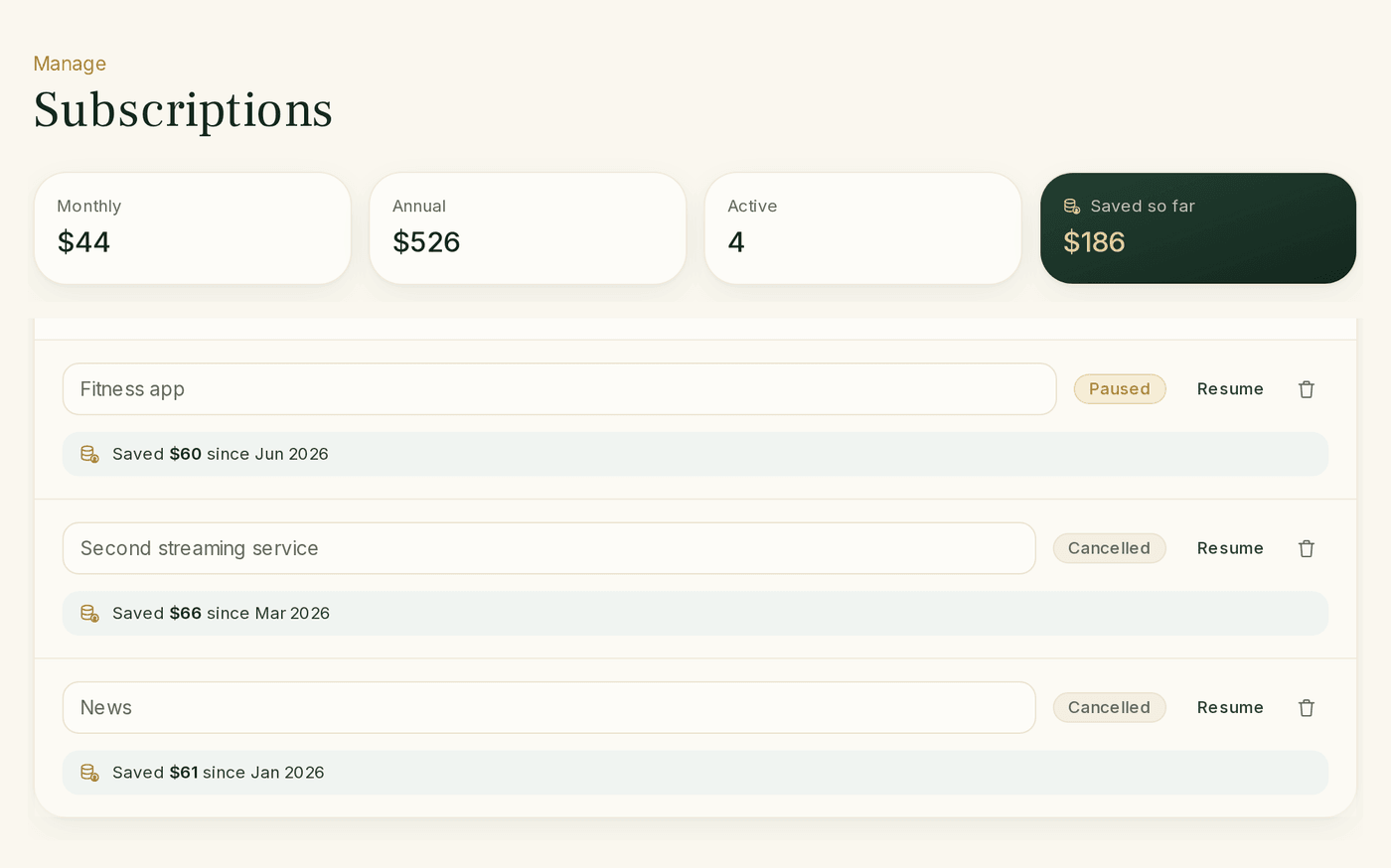
Heir has a dedicated subscription tracker for exactly this reason. You can see your recurring subscriptions together, what they cost you monthly and yearly, what you’ve paused or cancelled, and how much those decisions have saved you over time.
The point isn’t to celebrate cancelling everything.
If you use something constantly and it improves your life, keep it.
The goal is to make sure you’re still choosing it.
You might not need to feel this broke
None of these habits will magically fix an income that genuinely isn’t enough.
Sometimes the answer really is earning more.
But earning more is only one side of feeling financially secure.
The other is making the money you already have easier to see, easier to predict and harder to lose without noticing.
- Make spending tangible occasionally.
- Look backward before planning forward.
- Prepare for the expenses you already know are coming.
- Know what is actually available to spend.
- Recover value from things you no longer use.
- Let part of every raise stay yours.
- And know exactly which companies have permission to keep charging you next month.
You may still have the same income when you’re finished.
But your money might finally feel like more of it belongs to you.